Showing posts with label Canada. Show all posts

May 25, 2011

Rising Waters, Rising Delusions: Climate Change is Real, and It's Our Fault

"Flooding is a slo-mo disaster like climate change..." and it certainly isn't the only disaster the planet is facing. Canada and the US are facing a string of environmental disasters and hurricane season has yet to begin.

A short list of major events in the past month:
- May 24-25: Tornadoes in Oklahoma and Kansas and Arkansas, USA. 13+ fatalities
- May 22: Tornado in Joplin, Missouri, USA. 123+ fatalities
- May: Mississippi River Flood, All along the river (Illinois, Missouri, Kentucky, Tennessee, Arkansas, Mississippi, Louisiana)
- May: Flooding of Red River; Assinboine River, Manitoba, Canada; North Dakota, Minnesota, USA.
- April 25-28: Super Outbreak, Alabama and 20 other states, USA. 327+ fatalities

via SunSentinel.com
Speaking of climate change... do you think maybe the flooding and tornadoes* (not to mention the environmental impacts in other parts of the world) might be connected to climate change? I sure do.

* While these events may not be directly linked to climate change, especially not immediately due to lack of data. Climate change means extreme weather events may be stronger, more frequent, etc.

by Joel Pett via AAEC
What do you think?

Part of me agrees with Larry Powell, a long-time journalist, activist, photographer and writer based in rural, western Manitoba. I want to type: "It's Global Warning, Stupid!"

I don't know any climate change deniers but apparently they exist. According to this recent article, 9 out of 10 of the most prolific climate change denier publishers are linked to ExxonMobil. There are others who simply argue against changing the Western lifestyle model of over-consuming the planet's resources - because either it's too late, or it can't be done, or the economy would be compromised. In short, we can't afford to change.

But as many environmental activists have asked: Can we afford not to?


Even without the pressing issue of climate change, there are other reasons that we should care about the earth and everything on it. Climate change aside, humans are contributing to:
- rapid and significant loss of biodiversity
- fresh water shortages
- pollution: air, water, soil
- plastic pollution (heard of the gyres?)

Or, we could buy into some specie-ism (like sexism, but for species), and think about how we impact our fellow human beings through our interaction with them and the planet. Here are some examples of environmental racism from the USA:

Cancer Alley is an area in Louisiana formerly referred to as the Petrochemical corridor - where petrochemicals are processed. The population is composed of African-American and low-income individuals with little university level education, and there are high unemployment levels despite the industry. There are also high rates of cancer found in Louisiana (#2 in USA), as well as more incidents of rare cancers than normal.


Hurricane Katrina
severely impacted residents of New Orleans, Louisiana in 2005. Due to drilling and extending pipelines over the years, the wetlands, which are natural defences against soil erosion, were damaged which led to more severe flooding in harsh weather. Additionally, certain people had the means to leave the city (evacuation plans centered on individuals using their own cars to exit the city) while others did not. The division was clearly related to race, citizenship, income level, etc.

The BP Oil Spill in the Gulf of Mexico in 2010 affected subsistence fisher(wo)men and many others employed in the area. Certain populations were more severely impacted in the aftermath of the blow-out: immigrants, prisoners (essentially slave labour) and the impoverished fishing community were paid too little, if anything, to clean up oil and tar from the beaches and sea, and were not given appropriate protection for the bodies. Many became ill during or after working on the clean up.
And in Canada?
via Tree Hugger
The Tar Sands/Oil Sands in Alberta, Saskatchewan and Northwest Territories, have been described as one of the worst environmental disaster in the world. Aboriginal people in the region have not been included in the “development.” First Nations peoples have been neither consulted nor compensated for the destruction of the land and water. One specific case is of the Fort Chipewyan aboriginal people who have reported large increases in cancer rates as tar sands production has increased upstream; the fish are sick and inedible and many residents no longer drink the water.

What about people who don't have the privileges that come with being American or Canadian?
Texaco (acquired by Chevron, 2001) polluted Ecuador for decades and refuses to compensate local inhabitants. The Ecuadorian Amazon was polluted by Texaco from the time it began drilling without permission of the local population. The company cut costs by dumping 18 billion gallons of toxic waste water and 17 million gallons of oil, and abandoned more than 90 unlined/uncovered water pits filled with toxic sludge. The impacted indigenous peoples, mostly impoverished mestizo communities, had their water sources polluted, which has caused fish to disappear and become inedible, cancer rates have risen, many have experienced birth defects, etc. Chevron claims there’s no solid evidence; lawsuits were in courts in USA and Ecuador since 1993; recent ruling (Feb. 14, 2011) by Ecuador courts found Chevron guilty ($8.6 billion); currently, Chevron is fighting the judgement and denying wrongdoing.

via The Chevron Pit
So how is all of the above connected to flooding and tornadoes? In multiple ways. In a Lion King way, we're all part of the circle of life. In an Interlocking Systems of Domination theory way, different types of systemic oppression are interconnected and interdependent and we all occupy a location within each of these systems.
For example: racism, sexism, heterosexism and cultural imperialism all rely on each other. As a white, heterosexual, Canadian I privilege from systems that oppress others, but as a woman, sexism's raison d'être is to oppress me. All of these -isms rely on each other.

Sherene Razack clearly explains why we should be fighting against every type of oppression and inequality:
in focusing on our subordination, and not on our privilege, and in failing to see the connections between them… we fail to realize that we cannot undo our own marginality without simultaneously undoing all the systems of oppression (from Looking White People in the Eye, 1998).
And in the end, privilege will only get you so far if and/or when the Earth becomes uninhabitable.

May 24, 2011

Privilege and Prejudice

Let's start with privilege.

What a complicated concept.

It's not as simple as "have" and "have not." But "having it" to any degree automatically makes it harder to talk about in an insightful way. Without coming off like, well, a privileged dick.

I was born in, and live in Canada. My socioeconomic status is good. I'm university educated. I'm white. Cis gendered. Heterosexual. Able bodied.

What can somebody like me bring to the table when talking about privilege?

I can talk about what it meant to me, when a police officer in the city I grew up in, live in, and love, said that women should avoid dressing like sluts to avoid being sexually assaulted.

The comment led to outrage. In a concrete sense, it led to the creation of Slutwalk, a protest march to reclaim the word slut which has gone global.

So. The infamous statement by one misguided Toronto cop. I was outraged for a few reasons. Most significantly, I feel that it is absolutely appalling for a law enforcement officer to express this kind of victim blaming attitude. The way in which the message was delivered is harmful too: "we're not supposed to say this but..." i.e. "it's not publicly acceptable for us to express, but this is how cops really feel." This, in an already distrustful city. For the sake of simplicity, I'm going to assume we can all agree here and now that this kind of statement is unacceptable (even though I know there are many people who do hold this opinion).

But it also shocked me for a reason very much tied into the privilege discussed above. Due to the qualities I list above, I have tended to assume that cops will leave me alone. Not just that, I have assumed that cops have my best interests in mind. That they will serve and protect me.

This is an obvious example of what it really means to be privileged. It's not that I've never been hassled by the police, because I have been. But I think it's safe to assume that the "degree of hassle" would have been greater if I were, say, black. Homeless. A young man. A prostitute. Or in some way visibly outside the norm. 

I'm actually conflicted on whether I like the idea of Slutwalk or not. Something about it has never sat quite right with me, although I couldn't say what exactly until I read this excellent article. I agree that the ability to participate in a "Slutwalk" comes from a place of privilege, and that it doesn't necessarily do much to change the systemic problems created by, basically, slutshaming. On the other hand, I do think it's a really difficult problem to overcome because people who engage in slutshaming seem to me to have very deeply ingrained prejudices. And I think it's a worthy goal for women to reclaim and own their sexuality. (Also even though I agree with many of the above author's points, I do think using the words "white supremacy" in the title is more harmful than helpful. I idealistically believe feminists should go easy on each other even when we disagree with each other or think that others are acting in a way that is misguided. Maybe that's my privilege talking.)

Anyways. Privilege. Touchy topic. Most times when I read a piece by a privileged person talking about privilege, I feel that they get it wrong. And I'm not saying that to somehow claim that I've got it right, because I really don't know what I'm talking about.

But instead of opening up a slut-specific firestorm, I wish that this event would have led to a discussion of police prejudice and how it gets reinforced simply by virtue (vice?) of being a police officer.

Some police officers go into their careers holding certain prejudices. E.g., Black people commit more crimes. Natives abuse more substances. Girls dressed like sluts are more likely to be sexually assaulted.

Sidenote: I would like to put sluts in quotation marks for the entirety of this piece because I really do take issue with everything about that word. The idea that women who like sex deserve to be labelled by a derogatory term. The idea that such women dress a certain way. The idea that you can tell how much sex a woman wants by the way that she dresses. And of course, the idea that dressing a certain way is equivalent to consenting to sex.

Let's use the firestorm example. A police officer who believes sluts get raped, is more likely to find evidence to reinforce his belief. As the first level responders to crime, police witness, on a daily basis, the incidents the rest of us may only hear about, sporadically, perhaps diluted through whatever channel (e.g. news). Even demographics which are more likely to be victims of crime, probably don't witness the same amount as police do. If my hypothetical prejudiced police officer responds to 50 "sluts" and 50 "prudes" reporting sexual assault cases, he is nevertheless more likely to remember the evidence that confirms his beliefs, i.e., more likely to remember the "sluts." That's the nature of prejudice - it is self-perpetuating.

Secondly, there is actually a real reason that perpetrators might be more likely to prey on women dressed like "sluts" and it comes in two parts. One, rapists prey on vulnerable individuals. Individuals who won't be believed, or perhaps even heard. Two, if cops express the opinion that sluts deserve to get raped (or that they were asking for it, or that they brought it on themselves), they become a vulnerable population. See how that's a vicious cycle? It's not the manner of dress that's inherently problematic. It's the values that are attached to that manner of dress by people who hold power, such as police. And perpetrators.

created by Matt Bors

I want to acknowledge for a second all of the police officers and campaigns which have been progressive and pro-survivor and trying to understand the systemic problems. You rock. (And by the way, an interesting turn of events: I wrote this article prior to the May long weekend - on May 23, 2011, the Toronto police apparently launched a public awareness of sexual assault campaign).

Unfortunately for Toronto, the ball is getting dropped here. Now I know Slutwalk is about reclaiming the word slut and not explicitly f*ck the police (am I going to get arrested for writing that on the internet?). That's not my message either. I'm just pointing out the problem that stands out most obviously to me, and I don't think the Slutwalk movement is really addressing it.

As the members of the public who enforce the law, police officers should be trustworthy, accountable, and educated. I know that probably seems like a total pipe dream to people who are far more targeted by police than someone such as myself. And don't get me wrong, I'm not particularly hopeful myself. I'm not even sure what steps can be taken to progress towards that point. For one thing, can you even openly protest a police force without suffering some kind of serious consequences?

So for all that it's not perfect, I respect the organizers of Slutwalk for creating a movement that many people identified with and wanted to be a part of. Actual, physical mobilization always makes me happy to see.  And as a final statement, I do think that anybody who uses the word slut in a derogatory term, really does not deserve to get laid ever again in their life. So if Slutwalk is making people of all genders stand up for that cause, even if it's a privileged one, it's nevertheless a step in the right direction.

May 13, 2011

The Woman who Brought Down Gilles Duceppe

So the Globe has run an article featuring the Conservative who defeated Michael Ignatieff. It's an interesting read I suppose, but the person I'm really dying to hear about is Hélène Laverdière.

RE: Ignatieff. Maclean's covers it better than I can. His campaign was running out of steam that it never had to begin with. His loss was partly due to vote splitting which was a huge factor in Conservatives taking over Toronto. The news that he was losing his seat was shocking to me, but when CTV broke the news that Gilles Duceppe had been defeated in his own riding, my mind was completely blown.

I think it's safe to say that the NDP surge predicted by pollsters was met with hesitant enthusiasm/skepticism for more than a few reasons. First of all, the methodology of polling is imperfect. Moreover, learning of an NDP surge in Quebec could motivate voters in different directions (I do think it motivated Conservative voters for one thing). Not only that, but the NDP only held one seat in Quebec before this election, so I think it's safe to say they had a ways to go.

But boy, did they go there.

By the time I got down to watching election results, it was about 10:30 EST. So the first thing that flashed across my screen was the NDP declared as Official Opposition. This was one of my predicted election outcomes and I'm super excited to see what Jack Layton does from here.

Next up: Gilles Duceppe defeated.

Wait.

WHAT?!

It's one thing to say that Quebec is experiencing an orange surge. It's another thing entirely to bring down the once popular leader of the dominant party in Quebec for 20 years. Now my understanding is that Quebeckers voted, by and large, for the man and by extension the party, rather than the local candidate.

But in any case, I would really like us all to back off from Ruth Ellen Brosseau for a minute, and take a second look at Hélène Laverdière
Of all the seats in Quebec that could have been considered up for grabs in the 2011 election, arguably hers would not have been. However, the NDP found a damn good placeholder if they weren't expecting to win this seat. 

A previously unknown name in politics, Laverdière has worked as a foreign service officer for the Ministry of Foreign Affairs, working in various cities around the world.

She has a PhD in sociology from the University of Bath in England.

She speaks English, French, Spanish, and a little bit of Chinese. 

Post election, she stated that, "I did not run against Gilles Duceppe, but for the NDP."

And best of all, she won by over 5,000 votes! Amazing. I already love and admire this woman. Her win, to me, proves that Canadians should feel proud to vote for whichever candidate or party they truly feel deserves to win. The underdog CAN come from behind!

Now if only Stephen Harper had been brought down in HIS riding, then we'd be laughing all the way to the bank.

ETA: The Globe and Mail did eventually run a feature on other new MPs including Helene Laverdiere - you can read it here.

May 11, 2011

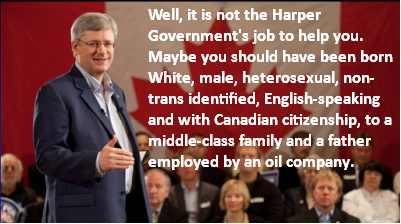
A 'Slash and Burn' Approach: Stephen Harper's Razing of Canada's Social Programs

The list below is a compilation of organizations and programs that have been cancelled, or had funding cut/reduced during the time Harper has been Prime Minister of Canada. This list has been floating around the internet for a while and I planned on posting it before the election. I think it is just as relevant following the election because we know who will be governing Canada for the next four years and we know what they are capable of. So this is a reminder of what has happened under the Harper government.
It is also a warning of what can happen in Ottawa - especially if the leaders that are paid by Canadian citizens to represent us are not held accountable. And who is going to hold them accountable? It'll have to be the electorate and the activists and the average citizens. It will also have to be the marginalized and their allies. Those of us with privilege - whether Whiteness, fluency in English or French, hetero-normative identity, university education or computer literacy - have a responsibility to recognize our social capital and use it to improve our society.
I do not take credit for compiling the list. I found several versions of the list, so I combined and cross-referenced them to avoid repetition. I also added the location of the organization and its website when relevant/possible. If you know who deserves credit for the list, and/or if you know of any organization or program that should (or shouldn't) be on this list, let me know in the comments!

Note: Obviously, the government cannot fund everything and my point is not that the government should fund everything. While I do think there were ideological motives behind the funding decisions, I admit that some cuts made were reasonable (especially in 2006). This CBC News page offers analysis of the cuts that reveals that some funding was unused and outdated (I didn't bother adding most of those to the list below).

To provide some perspective, I've categorized these organizations to help show what types of programs have lost funding. This is not scientific, but I did try to be consistent. Since most organizations address more than one issue ('cuz you know, all forms of oppression or marginalization are connected), the numbers probably won't add up.

 Women --- Social Justice --- Immigrants/Marginalized Communities --- Policy Research/Legal Issues --- General Community Services --- Education --- First Nations --- International Development ---
 Children/Child Care --- Employment --- Anti-racism/Multiculturalism ---
 Climate/Environment --- Health Care --- Internet Access 

Legend:  Yellow (<5)   Orange (5-10)   Pink (11-15)   Purple (15<) 


Now, onto the list. Under Harper's Regime (2006-2011) the following has occurred:

ORGANIZATIONS
Numerous community organizations, agencies, non-governmental organizations (NGOs), research bodies and programs have been cancelled, or had their funding cut or dramatically decreased:

A
Aboriginal Healing Foundation
Action travail des femmes (Quebec)

Alberta Network of Immigrant Women
Alternatives (Quebec)
Association féminine d’éducation et d’action sociale (AFEAS) (Quebec)

B

Bloor Information and Life Skills Centre (Toronto, ON)
Brampton Neighbourhood Services (Ontario)


C
Canadian Arab Federation

Canadian Child Care Federation
Canadian Council for International Co-operation
Canadian Council on Learning
Canadian Council on Social Development
Canadian Heritage Centre for Research and Information on Canada
Canadian Human Rights Commission

Canadian International Development Agency (CIDA) Office of Democratic Governance
Canadian Labour Business Centre

Canada Mortgage and Housing Corporation
Canada Policy Research Networks
Canadian Research Institute for the Advancement of Women
Canada School of Public Service
International Programs - Canadian Teachers' Federation
Canadian Volunteerism Initiative
Centre de documentation sur l’éducation des adultes et la condition feminine (Quebec)
Centre for Equality Rights in Accommodation (CERA)
Centre for Spanish Speaking Peoples (Toronto, ON)
Child Care Advocacy Association of Canada
 
Childcare Resource and Research Unit
Climate Action Network
Community Access Program
Community Action Resource Centre (CARC) (Toronto, ON)
Conseil d’intervention pour l’accès des femmes au travail (CIAFT)
Court Challenges Program (except language rights and legacy cases)
Court Commission of Canada

D

Davenport-Perth Neighbourhood Centre (Toronto, ON)
Democracy Council
Democracy Unit - Department of Foreign Affairs and International Trade (DFAIT)
 

E
Elspeth Heyworth Centre for Women

Environment: Youth International Internship Program 
Eritrean Canadian Community Centre of Metropolitan Toronto
Ethiopian Association in the Greater Toronto Area and Surrounding Regions
 

F
Feminists for Just and Equitable Public Policy (FemJEPP) (Nova Scotia)
First Nations Child and Family Caring Society
First Nations and Inuit Tobacco Control Program (Health Canada)
Forum of Federations
 

G
Global Environmental Monitoring System
 

H
Health Canada - Policy Research Program
Health Canada - Medical Marijuana Research Program

I

Indian and Northern Affairs Canada
Inter-Cultural Neighbourhood Social Services (Peel)
International Planned Parenthood Federation

Immigrants Settlement and Adaptation Program (ISAP) - Afghan Association of Ontario (Toronto, ON) 
 

K
KAIROS (of the infamous Bev Oda scandal)

L
Law Commission of Canada


M
Mada Al-Carmel Arab Centre
Marie Stopes International
MATCH International

Museum Assistance Program - Canadian Heritage
 

N
National Association of Women and the Law (NAWL)
Native Women’s Association of Canada

Natural Resources Canada - Enhancing Resilience in a Changing Climate (ERCC) 
New Brunswick Coalition for Pay Equity
Northwood Neighbourhood Services (Toronto, ON)
 

O
Ontario Association of Interval and Transition Houses (OAITH)
Ontario Coalition for Better Child Care
Ottawa Chinese Community Services Centre

P
Pride Toronto

 
R
Réseau des Tables régionales de groupes de femmes du Québec
Riverdale Women’s Centre in Toronto
Royal Canadian Mounted Police External Review Committee

S

Sierra Club of British Columbia
Sisters in Spirit - NWAC
Social Sciences and Humanities Research Council of Canada
South Asian Women’s Centre

SpeciaLink

Statistics Canada Long-Form Census
Status of Women


T

Technology Partnerships Canada (TPC) - Industrial Technologies Canada
Tropicana Community Services

W
Womanspace Resource Centre (Alberta)
Women’s Innovative Justice Initiative (Nova Scotia)
Women’s Legal Action and Education Fund
Workplace Equity/Employment Equity Program
 

Y
York South-Weston Community Services Centre (Toronto, ON)

Youth Employment Strategy Programs - Service Canada


P.S. To read about what others have said/done about the cuts and see the lists I cross-referenced, check out these sites: Rewind the Cuts, April Reign, mirabile dictu, JJ World Adventures and Rabble

May 8, 2011

Canadian Feminists: "The first woman to _____"

When we first started discussing this blog, the subject of Canadian feminists came up several times. We had trouble naming even a handful of women that were seen as pioneers for women's rights, especially in recent times.

Having studied various feminist scholars, I am aware of the influence that American movements have on Canada. An inspiring PhD student instructed a class on Racism in Canada at my university and he was thoughtful about including Canadian authors in the syllabus. I sincerely appreciate the effort he put into that syllabus; it has been one of the main resources I use not only for critical theories on race, but for specifically Canadian thinkers.

I hope to use this blog to bring some of the awesome Canadian women to light and discuss their impact on feminism, politics and social justice in our country and abroad. One challenge we faced initially was finding Canadian women that specifically worked for a feminist or social justice cause rather than being "the first woman to ______." But those women are important to recognize, so I'll start this "series" by reviewing some pioneering women in Canada's history (with the much-needed assistance of Wikipedia). Do any of these "firsts" surprise you?


35 Notable Firsts for Canadian Women
Notes:
i. I recognize that feminism is a fluid term and my definition of feminism is shaped by my place in time. But, these women were pioneers and embodied some feminist qualities, like equality, all the same.
ii. Most Canadians descended from immigrant families; a lot of these women immigrated to Canada from another region (e.g. Europe, the US, or the Caribbean)
iii. Many people and many accomplishments were excluded because they didn't fit my narrow methodological requirement of being "first" but if you're curious you should learn more about famous Canadian women and let me know in the comments how many awesome women I missed!


1. Founder of first hospital in North America (1645) & co-founder of the City of Montreal (1642): Jeanne Mance

2. First female police officer in Canada (1800s, in Nova Scotia) : Rose Fortune

Rose Fortune was born into slavery in the US in 1774
via The Canadian Encyclopedia

3. First woman to receive a Bachelor's degree in the British Empire from Mount Allison University (1875): Grace Annie Lockhart

4. First Canadian woman nuclear physicist & First woman to receive a Master's degree at McGill University (1901): Harriet Brooks

5. First female surgeon in Canada (1911): Dr. Jennie Smillie Robertson

6. First woman elected to the House of Commons (1921): Agnes Macphail

Agnes Campbell Macphail c. 1922
via The Agnes Macphail Website

7. First licensed Canadian female pilot (1928) & first Canadian woman to parachute into water: Eileen Vollick

8. First Canadian woman to earn a degree in aeronautical engineering (1927) & first North American woman to earn a Master's in aeronautical engineering (1929) & first woman elected to corporate membership in the Engineering Institute of Canada (1938) & first woman ever to chair a UN Committee (1947, Stress Analysis Committee) & world's first female aircraft designer: Elsie MacGill, OC
Elizabeth "Elsie" MacGill, OC
via glockoma

9. First female Canadian Senator (1930) & First female delegate for Canada to the United Nation General Assembly (1949): The Honourable Cairine Wilson

10. Medical director of Canada's first birth control clinic (1932-1966): Dr. Elizabeth Bagshaw, CM

11. First woman promoted to rank of colonel in Canadian Army (1940-1944): Colonel Elizabeth Lawrie Smellie, RN, CBE

12. First female member of the Canadian Cabinet (1957) & First female Acting Prime Minister (for one day in 1958): The Right Honourable Ellen Fairclough, PC, CC, O.Ont

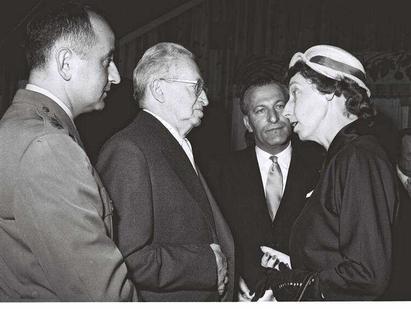
13. Canada's first woman ambassador (1958): Margaret Meagher, OC

Margaret Meagher (right) was Canadian Ambassador to Israel in 1959
via Wikipedia
14. First Canadian woman to jump over 6 metres in the long jump competition (1960s): Joan Hendry

15. First woman to seek leadership of a major political party (PC) in Canada (1967): Mary Walker-Sawka

16. First female publisher of children's books (1967) & First female mayor of Westmount, Quebec (1987-1991): May Cutler

17. First Canadian female solo singer to reach #1 on US charts and to earn a Gold record for "Snowbird" (1970) & First woman and first Canadian to win "Album of the Year" at the Country Music Association Awards (1984) & First woman to score a hole-in-one on the 108-yrd, par 3, 17th hole of the Kaluhyat Golf Club, NY (2003): Anne Murray, CC, ONS


18. First black Canadian woman elected to to Canadian provincial legislature (1972-1986 in BC) & First black woman to seek leadership of a major political party (NDP) in Canada (1975, second woman, after Mary Walker-Sawka): Rosemary Brown, PC, OC, OBC

19. First female Lieutenant Governor of Ontario & First female viceregal representative in Canadian history (1974-1980): The Honourable Pauline McGibbon, CC, O.Ont

20. First woman and first Canadian to compete in both the Summer and Winter Olympic Games in the same year (1976): Sue Holloway

Susan "Sue" Holloway competing at the 1976 Summer Olympics in Montreal
via Library and Archives Canada

21. First Aboriginal woman to earn a law degree in Canada (1976) & First woman appointed as Ontario Ombudsman (1989-1999) & First non-Parliamentarian appointed ex officio to a House of Commons committee: Roberta Jamieson, CM, LL.B, LL.D

Roberta Jamieson, CM, LL.B, LL.D
via Native Journal
22. First Governor General in Canada's history (1984-1990) & First Quebec woman cabinet minister & First female Speaker of the House & established first daycare for Parliament Hill: The Right Honourable Jeanne Sauvé, PC, CC, CMM, CD 

23. First black person appointed to the Canadian Senate (1984): The Honourable Anne Cools

24. First female black mayor in North America (1984): Daurene Lewis, CM

Dr. Daurene Lewis, CM
via Black History Society

25. First woman and first Canadian to win the National Cartoonists Society's Reuben Award (1985): Lynn Johnston, CM, OM

via www.fborfw.com
 26. First North American woman to reach the summit of Mount Everest (1986): Sharon Wood

27. First black woman to serve as a cabinet minister in Canada (1990): Zanana Akande

28. First woman and only woman to play in an NHL exhibition hockey game (1992): Manon Rhéaume

29. First Canadian female astronaut & First neurologist in space (1992): Roberta Bondar, OC, O.Ont, FRCP(C), FRSC

Roberta Bondar, OC, O.Ont, FRCP(C), FRSC
via famouscanadians.net

30.  First and only female Prime Minister of Canada (1993): The Right Honourable Kim Campbell, PC, CC, QC

31. First visible minority and first Chinese Canadian to be appointed Governor General (1999-2005): The Right Honourable Adrienne Clarkson, PC, CC, CMM, COM, CD, FRSC(hon), FRAIC(hon), FRCPSC(hon)

The Right Honourable Adrienne Clarkson, PC, CC, CMM, COM, CD
via http://adrienneclarkson.com/
32. First female Chief Justice of Canada (2000): The Right Honourable Beverley McLachlin, PC, CStJ, MA, LLB

33. First Jewish woman and youngest judge to sit on the Canadian Supreme Court Bench (2004) & youngest and first pregnant judge in Canadian history (1976): The Honourable Rosalie Abella, FRSC

The Honourable Madam Justice Rosalie Silberman Abella
via Supreme Court of Canada

34. First Muslim woman elected as a Member of Parliament (2004): Yasmin Ratansi

35. First black woman to serve as a viceroy and first person of Caribbean descent to be appointed Governor General (2005-2010): The Right Honourable Michaëlle Jean, CC, CMM, COM, CD, FRCPSC(hon)


Researching this topic helped me realize that there are so many women, from a variety of backgrounds, that have shaped Canadian history and there is so much I don't know about them.

Check back to find out more about the history of women in Canada and an introduction to more contemporary feminists in our nation.

April 20, 2011

Canada: What Does Our Democracy Look Like?

I am voting this election. And I hope that if you’re eligible to vote that you will too.

But I know that my vote is relatively benign because I am voting in a safe Liberal riding. Don’t get me wrong: I’m very grateful that I’m not in a safe Conservative riding. But still, it is mildly disheartening to know that my vote doesn’t really count. I know that voting is only one way to participate in a democracy. In fact, it is really a small part of it and takes place much less frequently in some other nations. I have increasingly put effort into other actions over the past few years, like calling and writing to my Member of Parliament (MP), party leaders, ministers, and the Prime Minister (PM) himself, to tell them what matters to me.

Some Canadians live in ridings in which there is a close race between the candidates and can make a big difference by casting their vote this election. Sites like 17votes and Project Democracy demonstrate how as few as 17 votes can decide who wins a riding. So, you should all go VOTE! But ultimately, my vote won’t change anything in my riding. My vote can help one of the political parties receive funding in the future (unless Harper scraps that law in his quest for autarchy). I’ve considered some strategic voting initiatives such as Vote Pair and Vote Swap, but since I need to mail in my special ballot, I am running out of time to find a match. In sum, I've realized that simply casting a vote on election day is not enough and I've been considering others ways to be democratically engaged.

I’ve been thinking about what our democracy looks like and have decided that we need to change. One change that is desperately needed in order to ensure more votes count: electoral reform! There are organizations working towards this goal, such as Fair Vote Canada. We should all learn more about the issue, then get involved and support them in order to make more of our votes count. Electoral reform would also help combat so-called “voter apathy”. Here’s a new approach to the idea of apathy:
In this TEDTalk, Meslin presents a compelling explanation for “apathy”, claiming that inaction is often due to multiple obstacles and barriers in society.

While electoral reform is important, we need to rethink what is happening between election campaigns. Canadians need to see voting as only a part of democracy and need to take action in other ways. We need to call our MPs, email our party leaders and contact relevant ministers. We need to protest, sign petitions and write to our newspapers regarding issues that matter to us and our neighbours. There are numerous other ways to get involved on a local level, such as joining neighbourhood associations, participating in community events and your municipal government, and engaging in your community. While these are all great ways to get involved, for the purpose of this post, I'm focusing specifically on federal politics.

Social media is the tool that youth (among other Canadians) are currently using to express themselves. We are using the internet to to spark change, spread information, support organizations and encourage each other. Among other initiatives: vote mobs, songs, tweets, emails, blogs, YouTube, websites, and comics. It’s all pretty awesome.

Leadnow’s Declaration of Change showed that Canadians are interested in getting involved. Participants indicated a desire for more direct avenues to participate in our democracy:
  • Create an open government plan to increase transparency and accountability
  • Initiate a citizen-led process for a referendum on electoral reform
  • Make it easier for people to participate directly in government decision-making
So yes, the movement to get out the vote on May 2 is important. But what if Canadians also called and wrote to their MPs? What if we did this not just before, but also AFTER the election. What if we wrote to our local newspapers as a way to share our opinions with others in our communities? It’s probably much easier for politicians like Stephen Harper when the electorate doesn’t offer many loud and/or united voices. So, let’s make it difficult. Social media is only the first step (albeit a significant one). 
We need to engage with people outside of our relatively progressive and informed youth/student community. We need to make this mainstream.

Intellectual Noam Chomsky has been critical of the expression “speak truth to power” and I think his reasoning should inform the movement to improve our democracy in Canada.


Chomsky elaborated in a 2010 interview in response to the questions: "Finally, why have you criticised the formula 'to speak truth to power,' which was used by the late Edward Said to describe the role of intellectuals?"

That's actually a Quaker slogan, and I like the Quakers and I do a lot of things with them, but I don't agree with the slogan. First of all, you don't have to speak truth to power, because they know it already. And secondly, you don't speak truth to anybody, that's too arrogant. What you do is join with people and try to find the truth, so you listen to them and tell them what you think and so on, and you try to encourage people to think for themselves.

The ones you are concerned with are the victims, not the powerful, so the slogan ought to be to engage with the powerless and help them and help yourself to find the truth. It's not an easy slogan to formulate in five words, but I think it's the right one.
So while we can call out corporations and politicians, we need to speak to people. We should definitely tell politicians what to do since they work for the electorate. But we need to speak to, and learn from, each other. We especially need to engage with those Canadians who aren’t likely to read posts about #cndpoli or be tweeting about the #elxn41.
As I finish writing this post, I’ve found a perfect example of what I’m talking about. Predictably this event appeared in my Facebook News Feed: I Pledge to Talk ShitHarperDid.com. (For those who are unfamiliar with this site, check out this post from last week or go straight to the source). The event calls for participants to not only tweet and post about politics (specifically Harper’s transgressions), but to actually TALK about it in real life. Below is text directly from the event:
We've already gone viral on the internet, now it's time to go viral on the original internet, IE. real life.

✔STEP.1
Pledge that every day between now and May.2nd you will tell a friend, family member or stranger one thing Stephen Harper has done, which you consider to be unacceptable.

✔STEP.2
Tell us about conversations you've had by sharing your experience on the event wall.

✔STEP.3
Invite your friends to this event!

✔STEP.4*
VOTE! Fri. Apr.22 / Sat.Apr.23 / Mon.Apr.25 / Mon.May.2
We should all do this all the time! Let’s talk about Harper. Let’s also talk about Ignatieff, Layton, May and Duceppe. Let’s talk about our local MPs, electoral reform, climate change and war. Let’s be part of more than a voter movement: let’s take part in some extra-ordinary direct democracy!
And for your viewing enjoyment, the latest video from ShitHarperDid.com:


"Stephen Harper is an Evil Astronaut" reminds us why we’re currently holding an election.

* There is still time to vote by special ballot (inside or outside Canada).

April 19, 2011

Everybody's Suddenly Talking about the Youth Vote

In the same way you can tell that Conservatives don't think they can win in my riding, it seems clear to me that political parties in general don't expect youth voters to turn out.

On one hand, we get accused of being apathetic (in fact I accuse myself). But on the other hand, I hope that politicians will find that youth voters are going to vote this year. I really have a good feeling about it. I know that's no Nanos poll accurate within 1.9 percentage points and I'm not advocating myself as a political forecaster. And I may be biased by being slightly older this time around. But it seems as though the people around me who are in my age group are more politically interested than in the last few elections.

I've been talking politics a LOT with a lot of different people. I've been seeing other people around me - mainly in the form of distant Facebook acquaintances - do the same. Yesterday I had an intense political conversation while drinking beer in a park on the way to a bar. I had another completely different conversation about politics IN the bar, with some guy I didn't really know! Both conversations were heated and intense and totally awesome. On top of that, the girl I was with took an Olivia Chow sign from a lawn (wow I'm really incriminating myself in this post aren't I?) and we got tons of hollers! The bouncer seemed to be concerned about whether he should let us reprobates into the bar given the legal implications of sign poaching. But eventually he said "As long as you're not voting Conservative" and waved us on. 

Not to mention we've got these vote mob thingys happening.

Even media outlets have started taking notice.

It gives me hope.

2011 has been a crazy year so far. People all over the world are creating political change. In a way, Canadians are deeply entrenched in a dysfunctional political system as well. Don't get me wrong, I seriously respect that I am extremely fortunate to live in a democracy - it's the best we've got. But we could still be doing a lot better.

Two years ago we saw our neighbours to the south elect Obama. I continue to be an insane Obama fangirl, although the U.S. are definitely still struggling in a rough patch. And okay, we don't have an Obama figure of our own but what we do have is choice! We don't just have to pick the lesser of two evils - it's more likely that there is a party with at least some policies we like (even if we're seeing a lot more politics than policy in this election). 

Further, youth tend to be less set in their ways – and therefore more open-minded to the choices that a multiple party system provides. At this point in the campaign, I’m still open to voting Liberal, Green, or NDP. Any of those parties could woo me. I would like to talk more about the campaign promises that are geared towards us and whether they hold weight or not (it would be a good educational opportunity for me), but to me it's clear that we are an afterthought. And hey, maybe this election we'll have an abysmal 30% turnout again, and politicians and politicos will continue to ignore young voters.

This brings me back to my original point, and yes I know it took a while to get here. I'm sure you could list a variety of reasons why parties don't appeal to young voters as much as say, all of this insane hoopla ha about immigrant votes and middle-class votes. I mean, Harper's just being realistic, for one. But they're wrong to ignore us because I'm undecided in this election, and I don't think I'm alone. 

The way I see it is that we can create change by proving that we are an engaged and intelligent electorate. Maybe not this election round, because the platforms have been released. But if we get out there and vote this year, politicians will be more likely to take our views more seriously the next time around! 

Then again, if we turn out and vote, who knows what our influence could be! Who knows, maybe we could still turn the tide in this election.

People our age are literally dying worldwide to gain the rights we take for granted. So people. Specifically young people. I'm serious here. Get out there, get informed, and vote!

We can make our voices be heard. We can, and we should, VOTE!